

Building custom collaborative project management software typically takes 4 to 9 months of development and a budget of €25,000 to €250,000 depending on complexity, compared with a generic SaaS subscription starting at €8 to €15 per user per month for a standardized solution.
A poorly chosen project management tool is costly: meetings that go nowhere, spreadsheets that contradict each other, information scattered across three different apps. This guide is for executives and CIOs considering whether to build project management software tailored to their own processes instead of settling for standard SaaS tools. We break down the design steps, the real budget to expect, and the mistakes that blow out timelines.
- Building collaborative project management software starts with a thorough analysis of business needs before a single line of code is written.
- Choosing the right core features — task tracking, communication, document sharing — determines whether teams actually adopt the tool.
- AI integration automates task assignment and enables predictive analysis of delay risks.
- Custom development fits real-world processes, unlike generic solutions that impose their own logic.
- Data security and scalability need to be designed in from the start, not bolted on afterward.
Why Invest in Custom Project Management Software?
Custom software fits internal processes exactly, whereas a generic solution like Monday or Asana forces its own workflows on you. According to a Syntec Numérique study published in early 2026, 61% of companies with more than 100 employees use at least three different tools to manage their projects, simply because they lack a unified solution suited to their needs.
This fragmentation carries a real cost: re-entering data, dashboards that don’t match up, time wasted reconciling information across tools. Custom software removes this friction by centralizing exactly the collaborative features the organization needs — no more, no less.
Custom Software vs. Generic SaaS: A Comparison
The table below compares the two approaches on the criteria that matter most in the decision: five-year cost, adaptability, and data ownership. For a 50-user team, a generic SaaS subscription comes to around €54,000 over five years, versus a custom build amortized at roughly €70,000 — but with no recurring per-seat cost.
| Criterion | Custom | Generic SaaS |
|---|---|---|
| 5-year cost (50 users) | ~€70,000 | ~€54,000 |
| Fit with existing processes | Full | Limited |
| Data ownership | Company | Third-party vendor |
| Time to launch | 4 to 9 months | A few days |
| Feature scalability | Unlimited | Depends on vendor roadmap |
| Vendor lock-in | Low | High |
In practice: beyond 40 active users and with specific business needs (multi-site projects, sector regulations, ERP integration), custom development pays for itself by year three of use. Below that threshold, a well-configured existing solution is usually faster to roll out.
What Are the Key Steps to Build Project Management Software From Scratch?
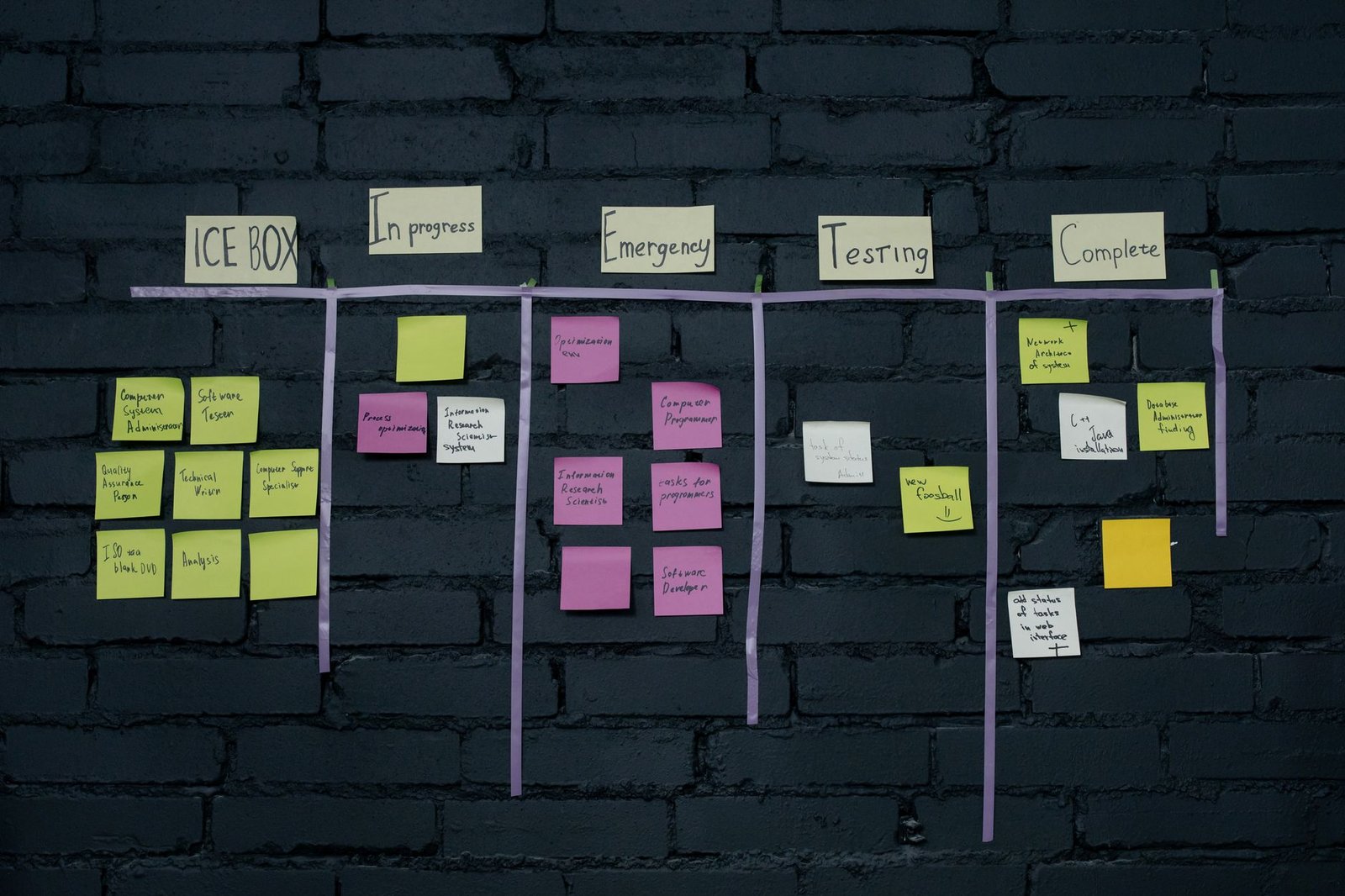
Building project management software from scratch follows eight structuring steps: scoping requirements, choosing a methodology, technical architecture, UI/UX design, iterative development, security testing, phased rollout with training, and then ongoing maintenance over several years.
- Scope actual business needs with frontline teams, not just management
- Choose a development methodology — agile, run in two-week sprints, is used in 80% of software projects according to the Standish Group
- Design the technical architecture and choose a cloud provider (AWS, Azure, or OVHcloud)
- Design UI mockups and validate them with a panel of end users
- Develop in functional batches delivered every two to four weeks
- Test data security, load, and edge cases before any deployment
- Roll out gradually and train pilot teams before the full rollout
- Plan for software maintenance and future upgrades over the next 24 months
Costly Mistakes to Avoid
The most common one: starting development without first observing how teams actually use their current tools. The typical outcome — a tool delivered after six months that simply reproduces the flaws of the old system, because nobody asked project managers what actually frustrated them. The second trap is prioritizing features over UX. Feature-rich but confusing software loses 30% of its active users within the first three months, according to feedback from agencies specializing in custom software development. The last, often underestimated point: the maintenance budget, frequently missing from the initial quote even though it typically runs 15 to 20% of the development cost every year.
How Can AI Optimize Your Collaborative Project Management Software?
Integrating AI into project management software makes it possible to automate task assignment, flag delay risks before they happen, and generate meeting summaries straight from the exchanges logged in the tool.
Three use cases stand out in 2026. First, predictive deadline analysis: by cross-referencing the history of similar tasks, a model can flag that a work package has a 70% chance of missing its deadline as early as the midpoint of the sprint. Second, the conversational assistant, which answers questions like “who’s working on what this week” without opening five different screens. And third, automated meeting summaries, which save a project manager an average of 3 hours a week, according to a McKinsey survey on AI in the enterprise conducted in late 2025.
AI in project management software is only as good as the data feeding it. A predictive model running on poorly logged tasks produces false alerts, and teams eventually start ignoring all of them.
The real trap is trying to automate everything at once. It’s better to start with a single function — delay detection, for example — and refine it over three months before adding a second one.
What Are the Essential Features to Include in Project Management Software?
High-performing project management software relies on six core features: task tracking with Kanban and Gantt views, contextual messaging, version-controlled document sharing, real-time dashboards, granular permission management, and smart notifications filtered by priority.
The classic mistake is copying a competitor’s feature list instead of starting from the team’s actual pain points. A construction SME doesn’t need a built-in invoicing module if it already runs a dedicated ERP — what it needs is clean synchronization between the two tools.
- Multi-view task tracking (Kanban, list, Gantt, calendar)
- Collaborative features: contextual comments, mentions, change history
- Document sharing with versioning and granular access rights
- Configurable dashboards and reporting by role
- Filtered notifications to avoid alert overload
- Offline mode for field teams without a stable connection
On the technical side, the best tech stack for project management software in 2026 typically combines React or Vue.js on the front end, Node.js or Laravel on the back end, and a PostgreSQL database hosted in the cloud for scalability. These web development technology choices directly affect how fast dashboards load — a detail that’s often overlooked until teams start complaining.
How Much Does It Cost to Develop Project Management Software, and How Do You Manage Your Budget?
The cost of developing custom project management software ranges from €25,000 for a simple MVP to more than €250,000 for a full multi-site platform, with an annual maintenance budget equal to 15-20% of the initial cost.
Custom Project Management Software Costs €25,000 to €250,000, Depending on Complexity
The cost of building project management software ranges from €25,000 for an MVP to €250,000 for a multi-site enterprise platform, based on consolidated data from French custom software agencies in 2026.
An underestimated budget at the outset often forces a scope rewrite midway through the project. Fixing the target complexity level first makes it possible to size the right budget before even issuing an RFP.
| Item | Value (€) |
|---|---|
| Simple MVP | €25,000 |
| Mid-tier | €65,000 |
| Complex | €140,000 |
| Enterprise | €250,000 |
The budget breaks down into three main categories: design and planning (15-20%), core development (55-65%), and testing plus deployment (15-20%). Software maintenance, often left out of the initial quotes, needs to be budgeted from day one — software that goes 18 months without a security update leaves the company exposed to known, documented vulnerabilities.
Three levers work well to keep development costs under control: breaking the project into deliverable phases (a working MVP before advanced features), negotiating a fixed-price contract rather than time-and-materials for well-defined phases, and building in a 15% margin for technical surprises — which are almost inevitable when integrating with an existing ERP.
Which Approach Fits Your Situation?
An 8-Person SaaS Startup in Its Early Stage
With such a small team and a need to validate the market before anything else, speed and minimal cost come first. What matters here: fast setup, a tight budget, quick iteration on the end product. The recommendation isn’t to build in-house project management software right away, but to use an existing SaaS tool for 12 to 18 months while processes stabilize, then consider custom development if needs turn out to be genuinely specific.
A 60-Employee Industrial SME Running Several Plants
Here, needs are already identifiable and recurring: production task traceability, ERP synchronization, field updates without a reliable connection. The deciding factors are integration with existing tools and offline reliability. The right move is to build targeted custom modules rather than a full platform — a budget of €40,000 to €70,000 generally covers this scope, versus more than double for unnecessary full custom development.
A 400-Employee Construction Group Working Across Multiple Sites
At this scale, organizational complexity (multiple sites, subcontractors, safety regulations) justifies a full custom platform integrated with the financial ERP. Key factors: data security across multiple job sites, fine-grained role-based permissions, and cloud scalability to absorb seasonal activity spikes. Budgets here typically exceed €150,000, but the alternative — stacking up SaaS licenses site by site — often ends up costing more over three years and complicates consolidated reporting.

FAQ: Building Project Management Software
What’s the Difference Between Project Management Software and an ERP?
Project management software organizes tasks, deadlines, and team collaboration around a specific deliverable. An ERP manages a company’s entire operations — finance, inventory, HR, production. The two can be connected, but ERP covers a much broader scope than project management alone.
My Team Is Small — Does It Make Sense to Build Custom Project Management Software?
Under 20 users, a well-configured generic SaaS solution costs less and can be up and running within days. Custom development starts to make sense at around 40-50 active users, or as soon as business processes become too specific for a standard tool.
What Are the Main Risks When Developing This Kind of Software?
The biggest risks are insufficient requirements scoping, underestimating the maintenance budget, neglecting data security from the design stage, and not involving end users during development — all of which undermine adoption once the software ships.
How Do You Get Your Teams to Actually Adopt the New Software?
Adoption hinges on three things: involving pilot users from the design phase onward, training teams before the full rollout rather than after, and migrating historical data to avoid weeks of double data entry.
Building custom project management software only makes sense if the initial scoping is solid and the maintenance budget is planned for from the outset. Once you’ve worked through this guide, the next step is to put together a detailed specification and run it by an agency specializing in custom software development that can accurately estimate timelines and budget before you commit to anything.
Frequently Asked Questions
What’s the Difference Between Project Management Software and an ERP?
The article doesn’t offer a direct comparison between project management software and an ERP. It mentions ERP integration as a specific business need that can justify building custom project management software.
My Team Is Small — Does It Make Sense to Build Custom Project Management Software?
For a team of fewer than 40 active users, a well-configured existing solution is usually faster to roll out. Custom development pays off beyond 40 users and with specific business needs, such as multi-site operations or ERP integration.
What Are the Main Risks When Developing This Kind of Software?
The main risks include starting development without first analyzing needs on the ground, neglecting UX — which can cost you 30% of your users — and leaving the maintenance budget (15-20% of the annual development cost) out of the initial quote.
How Do You Get Your Teams to Actually Adopt the New Software?
Adoption depends on choosing the right core features (task tracking, communication, document sharing) and a UI/UX design validated by end users. A phased rollout with pilot team training is also critical.
Related Reading
- Custom Software Pricing 2026: The Complete Cost Guide
- Accounting Software: The Complete Guide to Building One in 2026