






























 Landing page
 E-commerce website
 UX/UI design
 Business software & ERP
 SaaS software
 B2B client portal
 Web App & PWA
 Mobile app
 Artificial Intelligence
 Organic SEO
 AI SEO & GEO


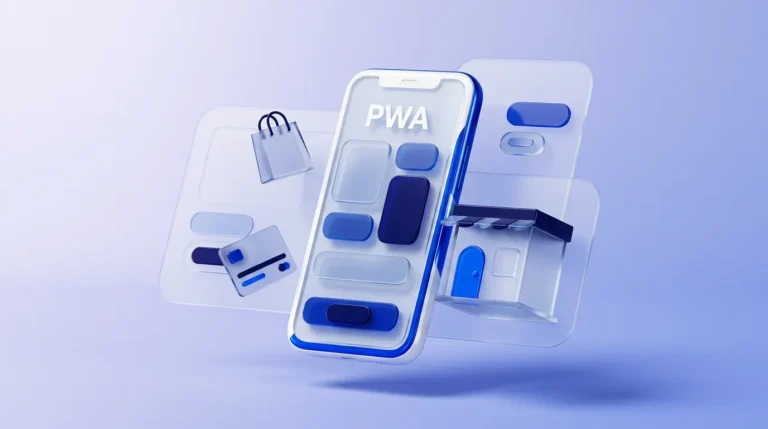
You run a small business, your budget is tight, and two options keep coming up in your searches: PWA vs native app. The problem is that nobody really explains the difference in concrete terms, how much it costs, what it changes for your customers, and, most importantly, what happens if you make the wrong choice. Let’s settle this without the jargon.
A PWA (Progressive Web App) is a website that installs on a phone without going through the App Store or Google Play, works partially offline, and can send push notifications. For a small business, it typically costs between €8,000 and €30,000 excluding tax, compared to €30,000 to €120,000 for a native app.
- A PWA is an enhanced website that offers mobile app features without going through the stores.
- For a small business, a PWA that leverages an existing web service starts at around €8,000 to €15,000, with annual maintenance at about 15% of the initial cost, compared to €15,000 to €70,000 for a cross-platform MVP.
- Native apps offer deeper integration with the operating system and maximum performance, but an iOS + Android MVP ranges from €30,000 to €120,000, with a timeline of 4 to 9 months.
- If your average order value is stagnating on mobile, a well-designed app can increase it by 15% on average and improve the conversion rate by up to 18% compared to a classic mobile site.
- A PWA is an agile solution for testing a market or offering a first mobile experience at a lower cost: a simple internal tool can be developed in 3 to 5 weeks for €6,000 to €15,000 excluding tax.
Hybrid mobile app, native mobile app, progressive web app (PWA): what are we talking about?
Three technologies serve three different purposes: a PWA is a website that behaves like an app, a hybrid app is packaged for the stores but developed with web technologies, and a native app is coded specifically for iOS or Android using Apple and Google tools.
The confusion often comes from the word “app.” Not everything that installs on a home screen necessarily went through a store, and not everything in a store is necessarily native code. Here’s how to really tell them apart.
The PWA: a site that behaves like an app
A Progressive Web App remains, technically, a website. It uses browser technologies to mimic the behavior of a mobile app: installation on the home screen, offline functionality (at least partially), push notifications. On Android, these capabilities have been mature for several years. On iPhone, it’s different: push notifications only work since iOS 16.4, and only after the user has added the PWA to their home screen, a manual step that many customers never take spontaneously.
The hybrid app: the historical compromise
A hybrid app is web code (often a PWA, in fact) wrapped in a native shell so it can be published on the stores. It provides access to phone APIs that the browser alone doesn’t always allow, while keeping a common development base between iOS and Android. It’s a middle ground: neither the pure performance of native, nor the update simplicity of a pure PWA.
The native app: the technical high-end
A native app is written in the language specific to each platform (or via a cross-platform framework like Flutter or React Native that compiles to near-native code). It accesses all the phone’s hardware without limits: sensors, Bluetooth, integrated payment, maximum graphics performance. This is the choice when the user experience (UX) must be flawless and the budget allows for it.

Can a PWA really replace a native app for my small business?
Yes, in the majority of cases for a small business: product showcase, order taking, loyalty program, booking. No, if you need advanced hardware access (advanced camera, Bluetooth, complex NFC payment) or maximum visibility on the app stores.
The question isn’t “is a PWA worse than native”, technically, it is, on some points. The real question is: “does your business need what native brings to the table?” For a hair salon wanting a booking system and reminder notifications, no. For a delivery app that needs to track a GPS position in real-time in the background, the answer leans towards native or a heavily customized hybrid.
The case by business type
A restaurant or fast-food business wanting a digital menu, click-and-collect orders, and promotional notifications: a PWA covers 90% of the need, with no store fees. A service business (beauty salon, garage, sports coach) wanting appointment booking and a client portal: same verdict, a PWA is more than enough. A retail store with in-store barcode scanning, real-time synchronized inventory management, or a loyalty program with a physical NFC card: here, hybrid or native regains the advantage, because these functions tap into the phone’s hardware more deeply.
What a PWA does better than people say
The PWA is no longer the bargain-basement version it was a few years ago. Modern browsers give it increasing access to sensors (geolocation, basic camera, vibrations), and, most importantly, some alternative stores are starting to accept PWAs directly, which reduces the visibility gap that once tipped the scales towards native. It’s not yet the norm everywhere, but the trend for 2026 is clear: the technical gap between the two worlds is narrowing, not widening.
The real risk for a small business isn’t choosing a PWA. It’s being sold an €80,000 native app when the actual need fits into a website that installs on a phone.

What is the real cost of a PWA compared to a native mobile app for a small budget?
A well-designed PWA starts around €8,000 to €15,000 if it leverages an existing web service, and a full MVP costs between €6,000 and €30,000 excluding tax. A native app, on the other hand, starts at €30,000 for an MVP and can climb to €120,000 for iOS and Android.
The delta isn’t just a matter of the starting price. You have to factor in application maintenance, which represents about 15% of the initial development cost each year, and this figure weighs much heavier in absolute value on a €100,000 native app than on a €15,000 PWA.
By project category, the orders of magnitude
Honestly comparing these two worlds also means comparing timelines. A PWA is delivered in a few weeks, a cross-platform native app takes several months. The table below shows an entry cost gap that can exceed €100,000 depending on whether a small business chooses a PWA or a full native app for iOS and Android, with development timelines following the same logic.
| Project Type | Cost (excl. tax) | Timeline |
|---|---|---|
| Simple internal tool (PWA) | €6,000, €15,000 | 3 to 5 weeks |
| PWA MVP | €6,000, €30,000 | 4 to 8 weeks |
| Cross-platform MVP (Flutter/React Native) | €15,000, €70,000 | 3 to 6 months |
| Native iOS + Android MVP | €30,000, €120,000 | 4 to 9 months |
| Verdict | Tight budget and simple need → PWA. Advanced hardware need and comfortable budget → native. | |
For a small business, this table reads simply: under €30,000, a PWA is practically the only realistic option to cover a real functional scope. Beyond that threshold, and only if the hardware need justifies it, native becomes conceivable, but the return on investment for a mobile app is built over 12 to 24 months, a horizon to keep in mind before signing.
The threshold that tips the decision
Here’s the trade-off that few articles state clearly: with a budget under €30,000, go with a PWA, end of story. Between €30,000 and €70,000, cross-platform (Flutter, React Native) becomes a serious option if you need a presence on the app stores for visibility or credibility reasons with your clientele. Beyond €70,000, pure native is only justified if performance or hardware integration is a selling point in itself, a game, a payment app, a technical professional tool.
What concrete projects show in the field
In the retail and e-commerce sector, some app projects have shown an average order value increase of 15% and a conversion rate improving by up to 18% compared to a classic mobile site. This gain doesn’t come from the technology chosen itself, PWA or native, but from the improved user experience: speed, fluidity, direct access from the home screen. A well-made PWA can capture a good portion of this gain, at a fraction of the native budget.
How to choose between a PWA or a mobile app for a small business: a simple decision matrix?
List your essential features, check if they require advanced hardware access, measure your available budget, and decide based on the urgency of your presence on the stores. For the majority of small businesses, a PWA checks the first three boxes without major sacrifice.
- List the truly essential features (not the ones that “would be nice”)
- Check if any of them require deep hardware access (Bluetooth, NFC, advanced sensors)
- Assess the budget actually available, including maintenance
- Estimate if a presence on the app stores is a trust criterion for your customers
- Test a PWA first if the budget is under €30,000
- Measure actual usage for 6 to 12 months before investing further
- Migrate to hybrid or native only if a concrete, measured need requires it
When neither a PWA nor native is the right answer
A business without a solid website or digitized ordering process wastes its budget by adding an app layer on non-existent foundations. The classic mistake: developing an app to bypass a failing site, which multiplies maintenance costs without solving the conversion problem. Investing first in a high-performance e-commerce site means building the foundation that a PWA or app will amplify later.
Based on your situation
An independent restaurateur with a single point of sale
They want an online menu, takeout orders, and evening promotional notifications. What matters: speed of deployment, contained cost, no dependency on store validation timelines. A PWA is the obvious choice here: timeline of 4 to 8 weeks, budget between €8,000 and €15,000 if it builds on an existing site, and no installation barrier for the customer.
A beauty salon network with multiple franchises
The need goes beyond simple appointment booking: a unified loyalty program across locations is required, sometimes a physical NFC card linked to the client account. What matters: brand consistency on the stores, advanced loyalty features. Here, a cross-platform MVP between €15,000 and €70,000 becomes relevant, because the gain in brand image and customer retention justifies the additional investment.
A retail store with in-store inventory management
They need to scan barcodes, synchronize inventory in real-time between multiple registers, and potentially access a card reader. What matters: reliability of hardware access, performance under heavy load. Native or a heavily customized hybrid takes the advantage, because these functions push the phone well beyond what a browser can guarantee stably.
Working on a project like this? See our dedicated page: web app development (pwa).
FAQ on PWA vs native app for small business
Can you “put a PWA on the stores”?
Yes, partially. A PWA can be packaged to appear on some app stores, notably via technical wrappers, but it won’t always have the same level of integration as a native app. Some alternative stores now accept PWAs directly, a strong signal for 2026.
Is a PWA good for my business’s SEO?
Yes, and it’s even a clear advantage over native. A PWA remains a website indexable by Google: it benefits from classic natural referencing (SEO), unlike a native app which is invisible to search engines until it’s installed.
What are the major drawbacks of a PWA for a small business owner?
Hardware access remains limited (certain sensors, advanced NFC payment), adoption on iPhone requires a manual installation step, and visibility on the historical stores (App Store, Play Store) remains partial compared to a native app.
How long does it take to develop a PWA for a small business?
Count 3 to 5 weeks for a simple tool, and 4 to 8 weeks for a full MVP with several features (ordering, loyalty, notifications). This is significantly faster than the 3 to 9 months required for a native or cross-platform app.
The choice between a PWA or a native app for a small business comes down to a cost and return criterion: a well-designed PWA starts around €8,000 to €15,000 if it leverages an existing web service, compared to €30,000 to €120,000 for a native iOS + Android MVP. The annual maintenance of an app represents about 15% of the initial development cost, a line item to integrate from the scoping phase. If your business needs a fast, economical, and easily scalable mobile presence, a PWA does the job in the vast majority of cases. At Skyward Agency, we scope this need with you before talking technology, request a consultation to assess, with a quote after scoping, which solution truly fits your project and your budget.