

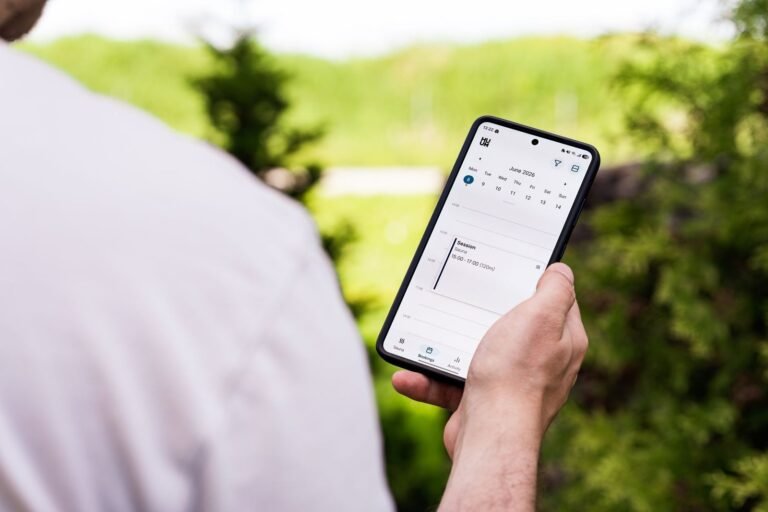
Build a booking app, and you’re essentially designing a digital tool that lets clients book a time slot online, complete with calendar syncing, payment processing, and automated reminders. A typical project takes 4 to 9 months and costs between €15,000 and €80,000, depending on the architecture you choose.
- Define your business needs and target audience
- Choose your technical architecture (native, hybrid, or PWA)
- Design the user journey and interface
- Build the back-end, database, and APIs
- Integrate payments and automated notifications
- Test the app on real devices
- Launch on app stores or as a web app
- Plan for ongoing maintenance and updates
- Nail down your requirements and target audience before making any technical decisions — the foundation of any solid booking app development guide
- Compare native, hybrid, and PWA builds: the cost gap can run as high as 6x
- Plan for slot management, automated reminders, and secure payment from day one
- Use AI for predictive scheduling and to cut down on missed appointments
- Build a realistic budget paired with a monetization strategy from the design phase onward
- Budget for ongoing maintenance: it typically runs 15 to 20% of the initial cost every year
Why Is Building a Booking App a Strategic Investment for Your Business?
A booking app cuts no-show rates by 30 to 38%, according to a 2026 Deloitte study of medical practices and beauty salons, while freeing up front-desk time billed at an average of €28 an hour in France.
Before diving into how to build a booking app, it’s worth understanding why the investment pays off in the first place — and the real payoff isn’t visible in the app’s first screenshot. It shows up in the books. A hair salon that loses three slots a week to no-shows loses, over a year, the equivalent of a full month’s revenue. Online booking, paired with an SMS reminder 24 hours ahead, shifts that ratio almost immediately.
Another underrated benefit: the data you collect. Every booking feeds a database you can use for digital marketing, targeted follow-ups, loyalty campaigns, and analysis of your least-booked time slots. Without an app, that information stays trapped in a paper diary or a spreadsheet, useless at scale.
A practice that digitizes its booking process isn’t selling clients a tech gadget. It’s selling them back their time — and that’s the benefit that justifies the budget, not the app itself.

How Do I Start Building a Booking App? The Key Steps From Idea to Launch
Building a booking app follows an eight-step process: scoping requirements, choosing an architecture, UX/UI design, technical development, payment integration, testing, deployment to app stores, and then ongoing maintenance for at least 24 months.
Whether you’re building a full-scale appointment system or looking at simpler steps to build a scheduling app, the process below applies either way. The second step — choosing your architecture — shapes everything that follows: budget, timeline, and how easily the app can grow later on.
Comparing Development Approaches in 2026: Finding the Best Tech Stack for Your Booking App
Native development costs, on average, three times more than a PWA, but delivers better performance for geolocation and push notifications — two features that matter a lot for a booking app with heavy daily traffic.
| Approach | Average timeline | Average cost |
|---|---|---|
| Native (iOS + Android) | 7 to 9 months | €55,000 |
| Hybrid (React Native) | 4 to 6 months | €32,000 |
| PWA (web app) | 2 to 4 months | €18,000 |
| No-code | 3 to 6 weeks | €9,000 |
In practice, a business with fewer than 10 employees rarely needs native development: a PWA covers 80% of booking-app use cases at a third of the cost. Native only makes sense past 50,000 monthly active users, once app smoothness becomes a real retention factor.
Costly Mistakes to Avoid During the Design Phase
- Starting development without an approved spec sheet: this can lead to up to 40% of code being rebuilt
- Skipping proper project management and interim milestones, a common source of budget overruns
- Undersizing the database for future growth
- Pushing data security questions to after launch
- Forgetting to test the booking flow on low-end devices
What Are the Essential Features of a Successful Booking App?
A successful booking app relies on five core features: real-time slot management, automated reminders, secure payment, multi-calendar syncing, and a simple interface that gets users booked in under three clicks from the home screen.
User experience (UX) makes the difference from the very first screen. A client who takes more than 90 seconds to book a slot abandons the process 60% of the time, based on figures commonly reported by booking SaaS providers. The user interface (UI) needs to strip the journey down to the essentials: pick a service, pick a time, confirm.
- Calendar synced with Google Calendar and Outlook via API
- Automated SMS and email reminders 24 hours and 2 hours ahead
- Secure online payment, with or without a deposit
- Cancellation handling and waitlists
- A business dashboard for managing multiple practitioners or resources
- Attendance stats and booking-rate analytics
On the technical side, the API isn’t a minor engineering detail — it’s what lets you connect the app to existing invoicing software or a CRM. Without a well-documented API, every future upgrade costs more than it should.

How Can AI Integration Transform Your Booking App?
Artificial intelligence improves booking through no-show prediction, automatic matching of the right practitioner to demand, and a chatbot capable of handling 70% of first-level questions without human input.
An algorithm trained on booking history can flag clients likely to cancel at the last minute and trigger a stronger reminder — sometimes an automated call instead of a plain text. Some healthcare platforms in the UK have cut no-show rates by 25% by combining this kind of scoring with a smart waitlist that automatically reaches out to the next available client.
The chatbot doesn’t replace front-desk staff. It filters. Questions about opening hours, rescheduling requests, confirmations — all of that can be handled without a human, freeing up staff to focus on the harder cases.
How Much Does It Cost to Build a Booking App — and How Do You Monetize It?
The cost to develop a booking application ranges from €9,000 for a no-code build to over €55,000 for full native development, plus another 15 to 20% of the initial cost every year for maintenance and security updates.
A Native App Costs Six Times More Than a No-Code Solution
Building a booking app costs, on average, €55,000 for native, €32,000 for hybrid, €18,000 for a PWA, and €9,000 through a no-code platform, based on average 2026 pricing from French agencies.
For a practice or small business just starting out, a PWA or no-code build is more than enough to validate the concept before investing in native. Native only pays off once you’re past a sizable base of active users, when performance starts driving real retention.
| Item | Value (€) |
|---|---|
| Native | €55,000 |
| Hybrid | €32,000 |
| PWA | €18,000 |
| No-code | €9,000 |
Three monetization strategies for booking apps dominate the appointment-scheduling market in 2026:
- Monthly subscription per professional or per business location
- Commission on each transaction or payment processed
- Freemium, with advanced features paywalled (AI, analytics, multi-calendar)
The subscription model stays the most predictable for cash flow, with average pricing between €29 and €79 a month for a small business. Commission-based pricing fits multi-practitioner platforms better, where transaction volume runs high.

Which Approach Fits Your Situation?
A Solo Physical Therapy Practice
One practitioner, one calendar, tight marketing budget. What matters here: getting online fast and keeping costs low. A PWA or no-code solution under €15,000 does the job, with optional online payment. Investing in native here would be way out of proportion with the actual number of monthly bookings.
A Chain of 8 Franchised Hair Salons
Multiple locations, multiple calendars to sync, and a need for consolidated stats per site. What matters here: multi-site management via API and a centralized dashboard. Hybrid development, around €32,000, strikes the right balance between cost and the ability to plug into existing point-of-sale software.
A Rural Veterinary Clinic With Poor Network Coverage
Unstable internet for a chunk of the client base, heavy reliance on the phone. What matters here: an app that still works in degraded mode, plus a reliable SMS channel rather than a data-heavy mobile app. A lightweight PWA with SMS reminders beats any data-hungry native solution in this case.
Working on a project like this? See our dedicated page: mobile app development agency in mauritius.
Frequently Asked Questions About Building a Booking App
How Long Does It Take to Build a Booking App?
Plan for 3 to 6 weeks with a no-code solution, 4 to 6 months for hybrid development, and up to 9 months for a complete native app with back-office, API, and integrated payment, testing included.
Native, Hybrid, or No-Code: Which Path Should I Choose for My Booking App?
Hybrid works well for most projects, cutting costs by around 40% and shortening the timeline compared to native. Native only makes sense once you’re past 50,000 monthly active users or need advanced hardware features like geolocation or sensors. And yes — you can build a booking app without coding at all: no-code platforms handle straightforward scheduling needs in just 3 to 6 weeks, though they offer less flexibility for custom integrations.
How Do I Keep My Users’ Data Secure in the App?
Encryption at rest and in transit, GDPR compliance, two-factor authentication, and regular security audits are the baseline. The database should also be hosted with an ISO 27001-certified provider for health-related data.
Can I Integrate My Existing CRM With the App?
Yes, through a dedicated API that syncs client records, booking history, and billing. Most CRMs on the market (HubSpot, Salesforce, and other specialized business tools) provide integration documentation you can work with right from the software development phase.
Ready to Move Forward With Your Booking App Project?
Deciding to create a booking app isn’t just a standalone IT project — it’s an organizational shift that touches front-desk operations, billing, and digital marketing across your entire business. The safest move at this stage is to scope your needs precisely with a team that understands both software development and project management, rather than jumping on the first provider you find. Let’s talk about your project and build a realistic spec sheet together, tailored to your budget and timeline.
Related Reading
- Project Management Software: The Complete 2026 Guide
- Accounting Software: The Complete Guide to Building One in 2026