

The essential food delivery app features for 2026 fall into three groups: ordering and payment for the customer, order management for the restaurant, and GPS tracking for the courier. A reliable system also adds AI-driven recommendations, real-time tracking, and a data analytics dashboard.
- Map out the customer journey (search, ordering, payment)
- Build the restaurant interface for menu and inventory management
- Integrate a geolocation module for couriers
- Add a rating and review system
- Connect payment and mapping APIs
- Set up a push notification system
- Plan a data analytics module to steer the business
- A 2026 food delivery app needs advanced AI capabilities for personalization and route optimization.
- Development cost ranges from €50,000 to over €300,000, depending on complexity and the number of features.
- Monetization relies on restaurant commissions, delivery fees, and advertising options.
- The technology choices you make directly affect the platform’s scalability and performance.
- An MVP (Minimum Viable Product) remains the safest way to launch quickly and iterate based on real feedback.
It took Uber Eats ten years to build the ecosystem we know today. You don’t have ten years. This guide is for founders and restaurant owners who want to understand what actually needs to be built, with which technologies, in what order, and for what budget — before signing with an agency or hiring a technical team. We’ll start with the food delivery app features that matter, work our way down to pricing, and finish with the mistakes that sink a launch.
What Are the Core Features of a Food Delivery App in 2026?
A food delivery app rests on three distinct interfaces — customer, restaurant, and courier — connected through a shared back office. Each one has its own must-have features for food delivery app success, and neglecting any single one breaks the overall experience, even if the other two are flawless.
For customers: ordering without friction
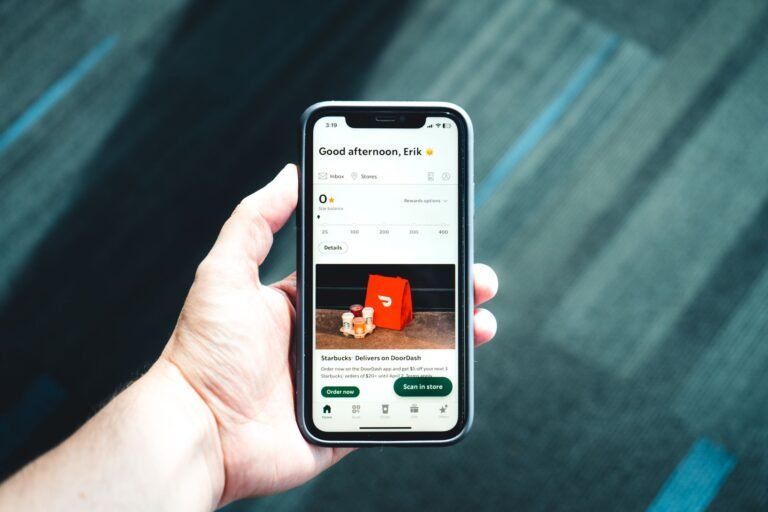
Customers want to find a restaurant in under 30 seconds, pay in two taps, and track their courier on a map. Geolocated search, filters by cuisine or allergen, integrated payment (Apple Pay, Google Pay, card), and in-app chat with the courier have become table stakes, not options. According to a 2026 Statista study, 68% of users abandon an order if checkout takes longer than 90 seconds. This is where the user experience is won or lost — in the small details that get dismissed as secondary during design.
For restaurants: managing without drowning
A restaurant owner receiving orders from three different platforms loses an average of 40 minutes per shift juggling screens. The restaurant dashboard needs to centralize menu management, real-time inventory, prep-time settings, and sales statistics. Without this piece, the app quickly turns into a burden instead of a revenue driver.
For couriers: optimizing the route
Last-mile logistics can make or break the profitability of the whole model. A smart assignment engine that can batch multiple orders along a coherent route cuts the cost per delivery by 15 to 20%, according to 2026 data published by FEVAD. Built-in navigation, real-time earnings tracking, and photo proof of delivery round out this piece of the puzzle.
Comparing App-Building Platforms by Option
The platform comparison below shows a cost gap of up to €250,000 between a no-code solution and a fully custom build, for very different levels of customization.
| Option | Indicative budget | Average timeline |
|---|---|---|
| No-code (Bubble, Glide) | €5,000 – €20,000 | 4 to 8 weeks |
| White-label template | €15,000 – €40,000 | 6 to 10 weeks |
| Custom low-code | €40,000 – €90,000 | 3 to 5 months |
| Fully custom development | €90,000 – €300,000+ | 6 to 12 months |
In practice: a no-code build works well for testing a local market with a single restaurant partner, but it hits a ceiling as soon as you need to manage several delivery zones or a high order volume. Fully custom development becomes necessary once you’re targeting multiple cities or a funding round.
How Do Food Delivery Apps Work? Choosing the Right Tech Stack for an App Like Uber Eats
Understanding how food delivery apps work — features and all — starts with the technology behind them: a distributed cloud architecture, third-party APIs for payment and mapping, and AI models for recommendations and delivery-time estimates. Your tech choices directly determine whether you can scale without a costly rebuild.
Think of the technical foundation in three layers: the application layer (mobile front-end), the server layer (back office and business logic), and the data layer (databases, caching, analytics). On mobile, two options compete: native (Swift for iOS, Kotlin for Android) and cross-platform (Flutter, React Native). Flutter now dominates delivery projects thanks to near-native rendering and a single codebase for both platforms — a 30 to 40% reduction in development time, according to feedback from French agencies in 2026.
On the server side, cloud providers (AWS, Google Cloud, Azure) let you absorb Friday-night order spikes without buying dedicated hardware. APIs play a structural role: payment (Stripe, Adyen), mapping and routing (Google Maps, Mapbox), and push notifications (Firebase). AI shows up in three specific use cases: dish recommendations based on order history, delivery-time prediction, and payment fraud detection. A well-designed analytics module turns every order into usable data for adjusting delivery pricing in real time.
The biggest technical trap isn’t choosing wrong between Flutter and React Native — it’s underestimating your cloud infrastructure from the start. We’ve seen apps handle 200 orders a day and collapse the moment a well-publicized partner triggers a traffic spike.
What Are the Key Steps to Building a Food Delivery App?
Building a food delivery app follows a precise sequence: requirements scoping, UX design, tech stack selection, MVP development, testing, launch, then iteration. Skipping the MVP step to aim straight for a full-featured version triples the budget with no guarantee of commercial traction.
- Define the business need and target delivery zones
- Design the user journeys (wireframes, mockups)
- Choose the tech stack and cloud architecture
- Build an MVP with only the key features
- Test with a small panel of pilot restaurants
- Launch in a limited geographic area
- Analyze usage data and adjust
- Gradually expand to other cities or features
What Features Should a Food Delivery App Have for Restaurants? A Special Case
A restaurant owner who wants to build an online ordering app without going through a marketplace like Uber Eats doesn’t need the multi-restaurant module or the courier-assignment algorithm. The real need boils down to a product catalog, online payment, and a kitchen order-management module. The budget then drops to between €8,000 and €25,000, versus a minimum of €90,000 for a platform open to multiple brands. This is a common mistake: many independent restaurant owners ask for a quote for an app “like Uber Eats” when what they actually need is ten times simpler.
The mistakes that cost the most
The first, classic mistake is trying to build everything before the first launch: AI recommendations, loyalty program, multiple languages. The result: 8 to 10 months of development for an app that never met its market. The second mistake concerns logistics: underestimating the real cost of the last mile, then discovering post-launch that margin per order is negative. The third, quieter one, touches on data security: pushing GDPR compliance to after launch, which exposes a startup to fines that can exceed €20,000, according to the CNIL.
Indicative Cost Breakdown by Project Type
A Food Delivery MVP Costs an Average of €65,000, vs. €280,000 for a Premium Multi-Restaurant Platform
Building a food delivery app costs on average €65,000 for an MVP, €150,000 for a standard version with AI and integrated payment, and up to €280,000 for a premium multi-restaurant platform with smart courier assignment.
These gaps show that it’s worth validating your market with an MVP before investing in a full-featured version. A founder who aims straight for the top tier takes on a financial risk that’s disproportionate to the service’s actual traction.
| Element | Value (€) |
|---|---|
| MVP | €65,000 |
| Standard | €150,000 |
| Premium | €280,000 |
| Multi-city | €320,000 |
How to Monetize Your Food Delivery App, and What Budget to Plan For
Monetizing a food delivery app relies on three main levers: the commission charged on every restaurant order (15 to 30%), delivery fees billed to customers, and advertising slots sold to partner restaurants. The development cost for a food delivery app ranges from €50,000 for an MVP to over €300,000 for a full-fledged platform.
Uber Eats’ business model took years to become profitable — real net margin per order remains thin, often under 5% once logistics costs are deducted. For a smaller project, targeting a 18–25% commission on restaurant sales, topped up with a €1–3 service fee per order, reaches breakeven faster. Some apps also add a monthly no-delivery-fee subscription, following the Uber One model, which builds loyalty and smooths out revenue.
What to really budget for
Beyond development, set aside 15 to 25% of your initial budget for digital marketing to acquire your first restaurants and first customers — without tackling this dual acquisition simultaneously, the app stays empty on both sides. Add an annual maintenance budget equal to 20% of the development cost for updates, data security, and evolving third-party APIs.
Why work with a development agency
Working with a development agency specialized in food delivery apps in France helps ensure GDPR compliance, adherence to PCI-DSS payment standards, and avoids architectural mistakes that are expensive to fix later. An experienced agency typically delivers an MVP in 3 to 4 months, versus 6 to 8 months for an in-house team new to the sector.

Which Approach Fits Your Situation?
An independent restaurant owner with two locations
The need here is to build loyalty with your own customer base without paying a 25% commission to a third-party marketplace. What matters: tight cost control, simple integration with your existing POS, and a short timeline. The recommendation is a dedicated online ordering app, built no-code or low-code, for a budget between €8,000 and €25,000, skipping the multi-courier logistics pieces that aren’t needed at this stage.
A startup targeting a regional marketplace
The challenge here is different: winning over dozens of restaurants and managing a fleet of independent couriers across 3 to 5 cities. The key criteria are technical scalability, smart order assignment, and acquisition speed. Some of the most unique features for a food delivery startup — like dynamic batching or predictive demand mapping — only pay off once you have real order volume, which is why an MVP priced between €65,000 and €100,000, launched in a single pilot city before expanding, remains the most rational choice. Targeting several cities right from launch multiplies the risk of failure without any validation data.
A restaurant group with 40 brands
Here, the logic changes entirely: the volume justifies a fully custom build, with AI-driven recommendations, a multi-site dashboard, and integration with existing POS systems. This is also where advanced features for food delivery apps — predictive analytics, dynamic pricing, cross-brand loyalty — start to earn their keep. The budget often exceeds €250,000, but the return on investment is measured through customer loyalty at the group level, not for a single brand.
Working on a project like this? See our dedicated page: mobile app development.
Frequently Asked Questions About Building a Food Delivery App
How long does it take to build a complete food delivery app?
A functional MVP typically takes 3 to 4 months with a dedicated team. A full platform, including AI, multi-restaurant support, and an advanced back office, takes 8 to 12 months. The timeline mostly depends on the number of API integrations and the complexity of the logistics.
Is it better to build a native or hybrid app for food delivery? Which Features Are Essential for a Successful Food Delivery App?
Hybrid frameworks (Flutter, React Native) suit most projects: 30 to 40% lower cost, one codebase for both iOS and Android. Native only makes sense if the app requires heavy graphics performance or deep hardware access, which food delivery apps rarely need. Among the essential features of a food delivery application, the tech stack matters less than getting the ordering flow, restaurant dashboard, and courier tracking right from day one.
How can you secure user data and payments in a food delivery app?
Use PCI-DSS certified payment providers (Stripe, Adyen) instead of handling banking data in-house. Encrypt personal data both at rest and in transit, build GDPR compliance in from the design stage, and run a security audit before every major update.
What are the main challenges to anticipate when launching a food delivery app, and are there unique features that make an app stand out?
The chicken-and-egg problem — recruiting restaurants and customers at the same time — remains challenge number one. Next come last-mile profitability, building loyalty against established giants, and handling order spikes without letting delivery times slip. As for standing out, the unique features for a food delivery startup usually aren’t flashy add-ons but small, well-executed details: transparent real-time tracking, fair courier payouts, and a restaurant dashboard that actually saves time instead of adding to it.
Building a high-performing app in 2026 isn’t about copying Uber Eats feature for feature — it’s about identifying the food delivery app features that genuinely fit your market, your budget, and your scale. The right instinct is still to start small, measure, then expand. If you want to accurately price your project and compare the technical options suited to your service area, talking with an agency specialized in food delivery app development will save you months of trial and error.
You might also like
- Building a Ride-Hailing App Like Uber: The 2026 Guide
- Why Every Restaurant in Cannes Needs a Local Digital Marketing Strategy